
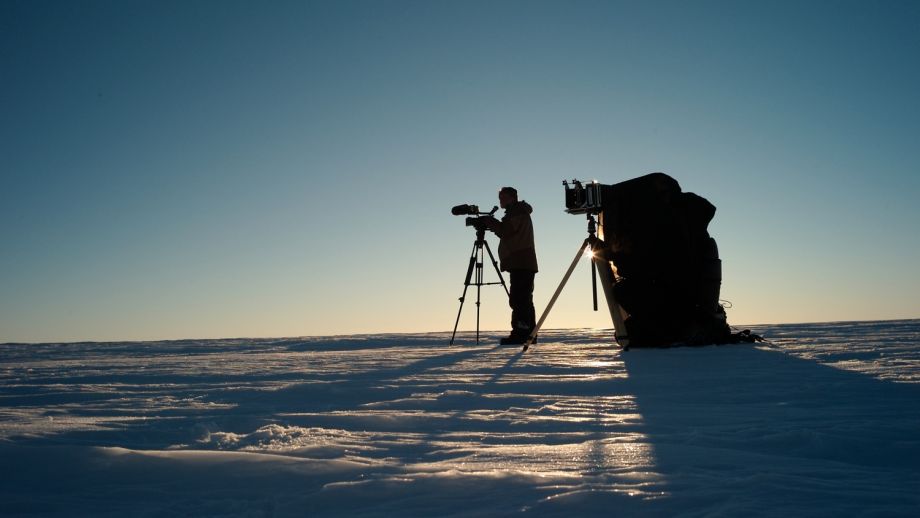
Unloading the Mary Arctica and First Traverse
The ship arrived at Crown Bay on the coast with a lot of equipment destined for the Princess Elisabeth station. Four tractors with sledges came to the rendez-vous point at Crown Bay to unload the Mary Arctica as swiftly as possible and take the containers back to the station.
-
The Mary Arctica finally made it to the coast after being blocked 150km out at sea by thick sea ice.
© International Polar Foundation
-
Meanwhile, the IPF team is coming from the station. It's a 20-hour trip by slow-moving Prinoth tractors. We have two drivers per tractor and we drive straight thought without stopping. While one drives, the other can sleep.
© International Polar Foundation
-
We have to refuel every three hours.
© International Polar Foundation
-
Having a little chat during a refueling on our way to the coast.
© International Polar Foundation
-
Jacques needs to wear extra sunglasses around midnight during his driving shift.
© International Polar Foundation
-
Unloading camp on top of the ice shelf, facing Crown Bay.
© International Polar Foundation
-
Only 3 hours of sleep and we venture onto the sea ice.
© International Polar Foundation
-
Evaluating the thickness and solidity of the ice before driving on it with the tractors.
© International Polar Foundation
-
The ice is good. One Prinoth goes in front to even out the unloading area.
© International Polar Foundation
-
Going on board to discuss and plan the unloading operation with Captain Pertersen.
© International Polar Foundation
-
Unloading the first helicopter. As you can see, we're standing on roughly 2 meters of sea ice.
© International Polar Foundation
-
The second helicopter.
© International Polar Foundation
-
Jacques Richon, our Swiss Mountain Doctor, is really fond of helicopters and quite happy to see these two.
© International Polar Foundation
-
Nighat Amin, who is in charge of logistics, is supervising the unloading operations.
© International Polar Foundation
-
The ship's crane lifting a container.
© International Polar Foundation
-
Unloading cargo.
© International Polar Foundation
-
Loading container on sledge with the Hammar side loader before taking it onto the ice shelf.
© International Polar Foundation
-
Every year, we build a ramp to be able to transport cargo from the sea ice to the ice shelf.
© International Polar Foundation
-
Invited on board for dinner.
© International Polar Foundation
-
Around midnight, the last container is unloaded and the ship prepares to leave.
© International Polar Foundation
-
Farewell after 18 hours of working together. It always feels a little strange to see them go.
© International Polar Foundation
-
Entitled to enjoy a few hours of rest before heading back to the station.
© International Polar Foundation
-
Refueling the fridge and freezer container before the journey back to the station.
© International Polar Foundation
-
On the road again back to Princess Elisabeth Antarctica. Scientists and engineers are waiting for their equipment.
© International Polar Foundation
-
Fixing a small mechanical problem one hour away from our destination. The hydraulic circuit of one of the tractors had a problem.
© International Polar Foundation
-
Problem fixed. Cleaning the oil before carrying on.
© International Polar Foundation
-
As soon as we got to the station, everybody was lending a hand to empty the fridge and the freezer.
© International Polar Foundation
-
Here we are: the first containers are neatly stored at Princess Elisabeth. More traverses will be needed to bring back the remaining ones we left on the ice shelf.
© International Polar Foundation


